Spotting Fake Digital Marketing Agencies: A Business Owner’s Checklist

Spotting Fake Digital Marketing Agencies: A Business Owner’s Checklist
Partnering with any service provider is a big leap and investment, so it’s hard to imagine how it feels to be deceived by a fraudulent operation pretending to be a digital marketing agency. Being aware of the red flags will help you confidently determine whether you’re dealing with a fake vendor or not. Read up on everything you need to know to spot a phony agency in this detailed guide.
In the digital world, where sophisticated technologies and techniques can blur the line between fake and genuine marketing agencies, businesses must stay vigilant.
This article shares common warning signs to identify fraudulent digital marketing agencies and actionable strategies for you to ensure that each agency you deal with is highly vetted.
Common Red Flags of a Fake Digital Marketing Agency
Success is a dream for any business owner. That’s why you’re pouring time and money into your marketing initiatives, hoping to ultimately gain lasting rewards.
Working with a digital marketing agency can be an effective way to achieve this. However, before letting them in, ask yourself: Are they trustworthy?
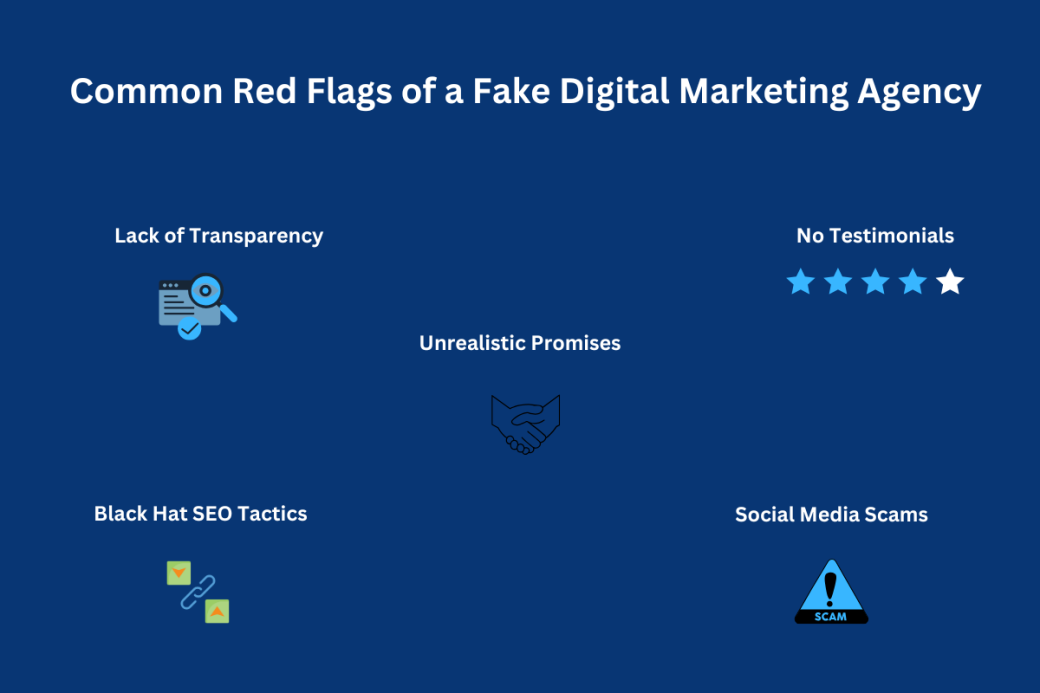
Watch out for these red flags that may indicate an agency is fraudulent:
1. Lack of Transparency
Transparency is critical when working with a digital marketing agency. It ensures no efforts are wasted, prevents misunderstandings, and produces satisfactory results.
If an agency lacks a clear pricing structure, withholds important details, or refuses to explain its services and strategies, it raises serious concerns about its credibility.
No Clear Pricing
A reputable marketing agency should provide a clear, itemized breakdown of all costs before any agreement is signed. Without this transparency, you may unknowingly pay for services you assumed were included.
Some agencies advertise low upfront prices but later add undisclosed fees for setup, account management, or essential services. Others bundle multiple services into a single package without detailing each service's costs, making it difficult to understand what you are actually paying for.
Vague Contracts
Disreputable marketing agencies often use deceptive tactics to mislead clients. A major warning sign is fine print overload, which is the excessive use of small, easily overlooked text in contracts, agreements, or ads.
This fine print hides essential details like extra fees, restrictions, or obligations, which leads businesses to pay more than expected. Even more concerning are vague contracts with no clear terms or deliverables. If an agency refuses to put commitments in writing, it’s likely setting you up for costly surprises.
2. Unrealistic Promises
When a marketing agency makes claims that seem too good to be true, it's likely an empty promise or a deceptive tactic. Here are the misleading guarantees they often make:
Claims of Instant Rankings or Guaranteed #1 on Google
Businesses that optimize their sites and produce good content are able to rank on Google's first page in three to six months. However, if the competition is high or the website isn't well-optimized, it might take six to 12 months. Nothing is guaranteed, as rankings depend on various factors.
It takes time and effort to rank well on search engine results pages (SERPs), as Google's algorithm and competition in your industry affect the outcome. If someone says they can put your site on the first page or number one spot on Google in a week or two, they're probably lying or scamming you.
Promises of Huge Traffic Increases With Minimal Effort
Some agencies promise massive traffic boosts with little effort, but much of it is junk—bots, click farms, and fraudulent visits that add no real value. This fake traffic wastes bandwidth, strains server resources, and distorts analytics, making it hard to measure real performance.
While numbers may look impressive, conversions stay flat. Focus on agencies that drive high-quality, engaged visitors who contribute to meaningful business growth rather than empty, inflated metrics.
3. No Verifiable Case Studies or Testimonials
Case studies and testimonials are powerful tools for generating leads and retaining customers. Be wary of agencies lacking these valuable resources or fake customer reviews.
Lack of Client References or Fake Testimonials
Client feedback and testimonials provide insights into an agency’s ability to deliver desired results and satisfy customers. Without client references, you can’t verify an agency's reliability and effectiveness or discover its strengths and weaknesses.
This raises concerns—was the service so poor that they didn't want you to speak with previous customers, or has the agency never served a real client? Some agencies also fabricate testimonials to appear more credible. These deceptive reviews create false expectations, leading to disappointment when reality doesn’t match the hype.
No Portfolio of Past Work or Case Studies
Crooked digital marketing agencies love to make bold claims about helping businesses achieve their goals. But when asked for proof, they have nothing to show—no portfolio, no case studies—just empty promises. Without tangible evidence, their expertise and experience are questionable.
Reliable agencies, on the other hand, back up their claims with a proven history of success. They provide case studies with concrete examples of how they addressed challenges and met objectives. These insights give you a clear understanding of their tailored strategies and solutions.
4. Black Hat SEO and Spammy Tactics
Some of these fake agencies might deliver jaw-dropping results instantly, like flooding a site with backlinks and making it rank high on organic searches for specific keywords. But the shock wears off fast when these fleeting gains vanish, as they are built on dishonest and unethical tactics.
Using Shady Strategies
Avoid shady agencies like black hat SEO (Search Engine Optimization), which manipulates search rankings instead of building genuine authority.
One black hat SEO technique is keyword stuffing, where excessive keywords are forced into content and meta tags. This makes the text difficult to read and unhelpful to users. Another is link farming, which creates networks of low-quality websites linking to each other to falsely boost rankings without providing real value.
Meanwhile, private blog networks (PBNs) take advantage of expired domains with strong reputations, copying or repurposing old content while inserting backlinks to boost another site’s ranking.
Websites involved in such practices violate Google Search Essentials and face penalties, such as lower rankings or complete removal from search results.
Buying Backlinks or Using Spammy Automation Tools
Earning backlinks based on the merit of one’s content through outreach and networking takes time and effort. To speed up the process, some businesses hire agencies that buy backlinks.
However, these agencies often acquire links from low-quality, irrelevant, or spammy websites or sources solely to provide backlinks and manipulate Google’s algorithm.
Others even use automated tools to generate large volumes of artificial backlinks. Such tactics can harm your site's credibility, lower its rankings, and even result in penalties.
5. Paid Ads and Social Media Management Scams
Expect the worst-case scenario when bad digital marketing agencies take charge of your social media and paid ad campaigns. Instead of attracting genuine leads and boosting return on ad spend (ROAS), they deceive you with fake metrics and drain your budget.
Fake Social Media Engagement
Don’t fall for agencies promising influencer collaborations and high-impact campaigns. Many showcase accounts with thousands of followers, but these numbers are often fake. Fake followers don’t engage, buy, or add value to your business.
In the third quarter of 2024, Facebook removed 1.1 billion fake accounts, many created for malicious purposes or tied to non-human entities.
For instance, scammers can create Instagram profiles, buy followers, and create the illusion of influence. However, you will notice that only a few like or comment on such accounts' posts.
This is because the engagement ratio remains low, which reveals the lack of real audience interaction. Some may also buy likes and comments, but that can also be easily detected as they show unusual spikes in activity.
No Conversion Tracking for PPC
Conversion tracking is the foundation of a successful Pay-Per-Click (PPC) campaign. It reveals which keywords, ads, and campaigns drive valuable actions after users see your ads, such as newsletter sign-ups, form submissions, or purchases.
Your PPC ad might generate a decent number of views or clicks, but something is wrong if website traffic and conversion rates are low.
Conversion tracking helps you identify the exact issues causing poor campaign performance. For example, you may need to update your ad copy or landing page to better align with your target audience.
If an agency ignores proper conversion tracking, such as using Google Analytics to monitor user interactions, and instead prioritizes vanity metrics like impressions and clicks that do not necessarily translate to actual business results, that is a red flag. It means they are draining your ad budget without delivering a real return on investment (ROI).
Mismanaged Ad Budgets
A Next&Co report shared by Mediaweek stated that Australian advertisers wasted $123.1 million in digital advertising during Q2 2024, which is one of the highest quarterly losses on record.
Deceptive digital marketing agencies drain PPC budgets through inflated costs and hidden spending. They may overcharge for ad placements while directing traffic to low-quality sites riddled with bots.
Some manipulate reports and fabricate engagement metrics to justify excessive fees. Others claim to run high-cost Google Ads but secretly funnel traffic through cheap, ineffective networks.
This exposes how these schemes rob businesses of real ROI. Without full transparency, you risk paying for worthless clicks. Always demand direct platform access, detailed reports, and clear breakdowns of ad spend.
How To Verify a Digital Marketing Agency
Now that you know how to spot a fake digital marketing agency, you must ensure there’s no chance of engaging with one. These effective tips can help you find the right partner for your business:
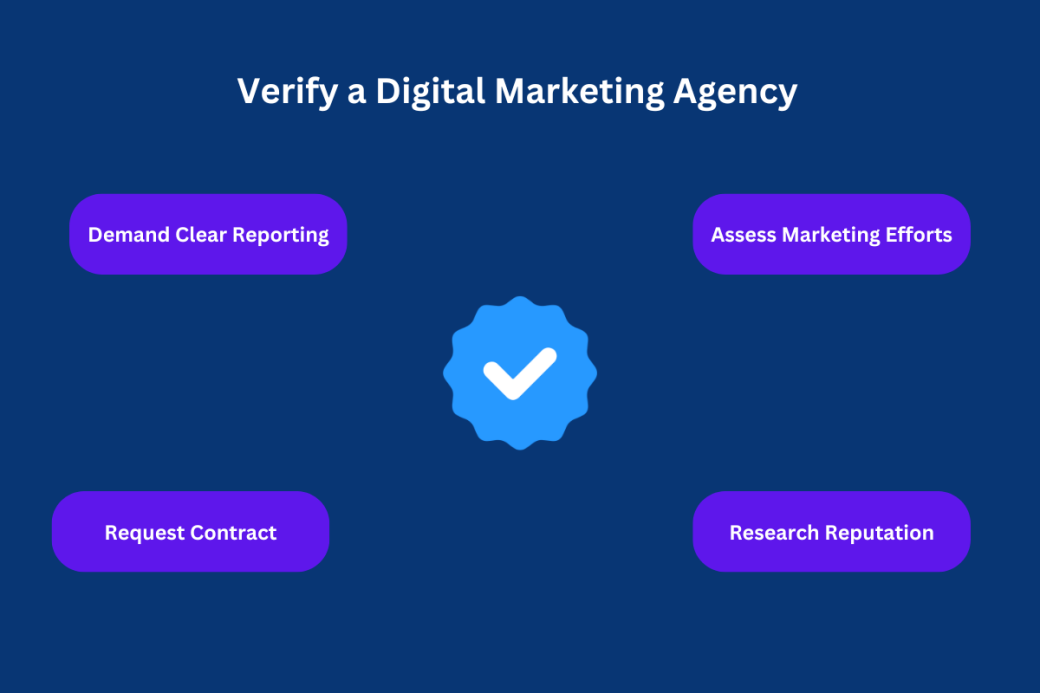
Research Their Online Reputation
Read comments, reviews, and discussions on Clutch, The Manifest, and other professional forums. Note common themes, both positive and negative. Watch out for fake reviews, like sudden increases in positive or negative reviews or identical wordings in multiple posts.
Moreover, consumer protection websites such as the Better Business Bureau (BBB) and Ripoff Report collect, authenticate, investigate, and release complaints, scams, and fraudulent activities organizations and individuals report.
Through these platforms, you can spot red flags, identify patterns of misconduct, and make informed decisions to avoid agencies engaged in unethical or deceptive practices.
Assess Their Own Marketing Efforts
A digital marketing agency is expected to be an expert in the field of marketing. Therefore, they should be able to professionally and effectively build trust and credibility based on their knowledge and expertise.
Ask for customer endorsements and public testimonials. Let them showcase the feedback of previous clients to validate their performance and service quality.
Does the agency practice what they preach? Check their backlink structure, how they rank for organic search terms, and samples of ads. See if their blog titles and meta tags are optimized. Moreover, evaluate their follower count, posting frequency, hashtag usage, and responses on their own social media channels.
Demand Clear Reporting & Metrics
Partner with agencies that are transparent in reporting and analytics. Request comprehensive and clear reports and KPIs (Key Performance Indicators) to measure and assess their campaign performance and effectiveness.
These are the engagement rates, conversions, traffic to your website, and ROI. You can gauge whether the agency meets your needs and objectives from these.
Avoid spending time on marketing agencies that do not disclose their strategy or metrics. Success takes place through clearly defined, custom strategies that address your business and industry's particular issues. Strong marketing is built on transparency and accuracy, not unsubstantiated claims or boilerplate strategies that don't bring returns.
Request a Contract & Deliverables
An agency should engage in a business relationship built on clear, mutually agreed terms to
protect your business interests, ensure smooth collaboration, and avoid costly legal battles. A formal agreement must outline expected deliverables and outcomes, timelines, payment terms, content ownership, and success measurements to maintain transparency and accountability.
You should think twice if an agency wants to lock you into a long-term contract. You'll be obligated to pay even if the agency is not providing added value. This leads to an unpleasant client-agency relationship and declining ROI.
The agency might also be less incentivized to deliver excellent work since they know you cannot just end the contract, regardless of whether they achieve the desired results.
Be Smart with Spotting Fake Digital Marketing Agencies
Avoiding fake digital marketing agencies is key to protecting your business. Watch for red flags like hidden fees, unrealistic promises, and fake testimonials. Choose agencies with a proven track record, transparent pricing, and clear reporting. Doing your research ensures a trustworthy partner that drives real growth.

Mike Hakob
Founder & CEO, Andava Digital